
Task-Prioritization for Faster Execution#
Efficiently scheduling experiments is crucial for minimizing execution time when running experiments in parallel. By controlling the order in which experiments are executed, you can ensure that worker processes remain busy for as long as possible, avoiding idle time.
Why Prioritize Experiments?#
Consider the following example with three experiments:
Experiment A takes 1 second
Experiment B takes 2 seconds
Experiment C takes 3 seconds
Case 1: Non-Optimal Order#
If we run the experiments in the order A → B → C, the total execution time is 4 seconds (Fig. 1):
Worker 1: Executes A (1s) and C (3s), totaling 4 seconds.
Worker 2: Executes B (2s), leaving it idle for the remaining 2 seconds.
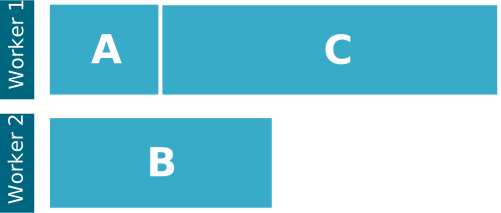
Figure 1: Non-optimal execution order#
Case 2: Optimal Order#
If we run the experiments in the order C → B → A, the total execution time is only 3 seconds.
Worker 1: Executes C (3s).
Worker 2: Executes B (2s) and A (1s), totaling 3 seconds.
This is the optimal way to schedule the experiments, as shown in Figure 2.
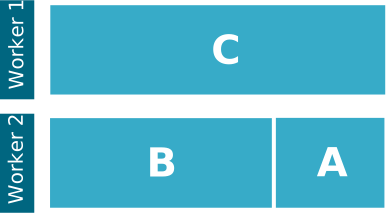
Figure 2: Optimal execution order#
Rule of Thumb: Execute Longest Experiments First#
Scheduling the longest experiments first helps to keep all workers busy for as long as possible, minimizing the total execution time.
Controlling Execution Order with Priorities#
You can control the order of execution using priorities. To enable this feature:
- Set the enable_priorities flag to True (either in the constructor or
by setting sweep.enable_priorities = True).
- Assign a priority to each experiment using the priority attribute.
Higher priority experiments (e.g., priority 3) will be executed before lower priority ones (e.g., priority 1).
By default, all experiments have priority 0.
Negative priorities are also allowed.
Example: Comparing Execution with and without Priorities#
Let’s revisit the example above and see the difference when priorities are used.
import time
from sweepexp import sweepexp

def my_slow_function(wait_time: float) -> dict:
    time.sleep(wait_time)
    return {}

sweep = sweepexp(
    func = my_slow_function,
    parameters = { "wait_time": [1, 2, 3] },
    mode = "parallel",
)
# We want to measure the total duration of the experiments
start_time = time.time()

sweep.run(max_workers=2)

# Print the total duration
print(f"Total duration: {time.time() - start_time:.2f} seconds")
This script will output:
Total duration: 4.12 seconds
import time
from sweepexp import sweepexp

def my_slow_function(wait_time: float) -> dict:
    time.sleep(wait_time)
    return {}

sweep = sweepexp(
    func = my_slow_function,
    parameters = { "wait_time": [1, 2, 3] },
    enable_priorities=True,
    mode = "parallel",
)
# Set priorities (higher number -> first executed)
sweep.priority.data = [1, 2, 3]

# We want to measure the total duration of the experiments
start_time = time.time()

# Run the experiments in parallel with MPI
sweep.run(max_workers=2)

# Print the total duration
print(f"Total duration: {time.time() - start_time:.2f} seconds")
This script will output:
Total duration: 3.12 seconds
As you can see, by setting the priorities, we can control the order in which experiments are executed, and optimize the total execution time.